


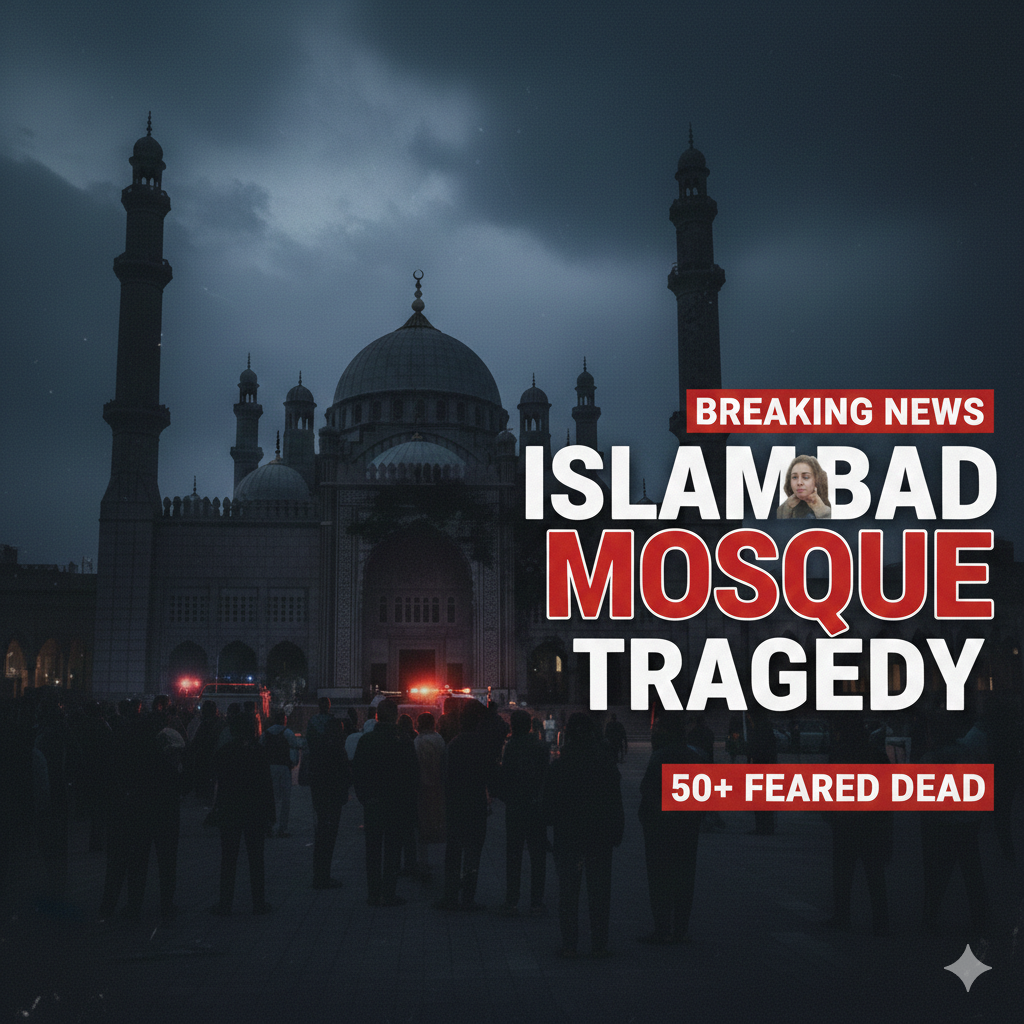
50 Feared Dead: Why This Islamabad Attack Changes Everything for Pakistan.
News Highlights: 5 Key Points
-
The Casualty Toll: Official figures confirm 31 deaths, while emergency responders at the site fear the toll has already crossed 50 due to the severity of injuries among the 169 hospitalized.
-
The Attacker’s Identity: Investigative agencies have identified the bomber as Yasir, a Pakistani national from Peshawar, who reportedly spent five months training in Afghanistan before the Islamabad suicide attack.
-
ISIS-P Claims Responsibility: The Islamic State – Pakistan Province (IS-P) officially claimed the attack via its Amaq News Agency, describing the Shia community as a “primary target.”
-
Security Breach in the Capital: This is the deadliest incident in Islamabad since the 2008 Marriott Hotel bombing, raising urgent questions about the security apparatus in the capital.
-
Immediate Arrests: In a series of overnight raids following the Islamabad suicide attack, police arrested three individuals in Peshawar, including the mother and brother of the alleged suicide bomber.
Islamabad Under Fire: The Heart-Wrenching Truth Behind the Friday Mosque Blast — Islamabad Mosque Blast Explained
Islamabad Mosque Blast has shattered the calm of Pakistan’s capital, leaving devastating carnage, anguished families, and intense political fallout in the wake of one of the deadliest attacks in years. What happened inside the Khadija Tul Kubra mosque during Friday prayers has shaken not only Islamabad but the entire region — and the truth behind this terror crime reveals chilling patterns of violence, sectarian targeting, and diplomatic fires that may burn for weeks to come.
On February 6, 2026, during congregational Friday prayers, a suicide bomber struck the Khadija Tul Kubra Shiite mosque in the Tarlai Kalan suburb of Islamabad, triggering a horrific explosion that killed at least 31 worshippers and wounded more than 169 others. Worshippers inside the mosque were caught in a scene of chaos, grief, and ruin — a massacre that will linger in the memories of the survivors.
1. The Blast: A Calm Friday Turned to Carnage
The Islamabad Mosque Blast took place shortly after Friday prayers began at around 1:30 pm local time. The congregation had gathered for their weekly ritual when the blast ripped through the mosque. Witnesses described hearing gunfire at the entrance, followed by a roar of deafening explosion that ripped through the prayer hall.
Muhammad Kazim, a 52-year-old worshipper who narrowly escaped, told reporters that gunshots rang out and then a powerful detonation tore apart the building while people were still in prayer positions. The force of the blast scattered debris, shattered windows, and left bodies strewn across the carpeted floors and gardens outside.
Security guards outside the mosque reportedly tried to intercept the attacker, halting him at the mosque gate. Despite their efforts, the bomber detonated his explosive vest near the entrance when stopped, causing mass casualties among the worshippers who were still inside.
Hospitals in Islamabad, such as the Pakistan Institute of Medical Sciences (PIMS), declared emergencies as shocked citizens rushed in with the wounded — many in dire condition. Rescue teams worked frantically to treat victims and transport them to medical facilities across the city.
2. Who Was Behind the Attack? The Claim of Responsibility
Shortly after the explosion, an affiliate of the Islamic State (ISIS) group claimed responsibility for the attack. The group released statements through its network, identifying the bomber as one of its operatives and framing the attack as part of its ongoing sectarian campaign against Shia Muslims.
The claim was also supported by monitoring groups that track jihadist communications. While Pakistan’s security forces continue to investigate, the admission by ISIS underscores an alarming resurgence of extremist networks capable of carrying out sophisticated suicide attacks in major urban centers.
ISIS’s claim illustrates a disturbing pattern: sectarian violence is being used as a weapon to instigate fear, fracturing communities already under stress from political and economic turmoil. Attacks against minority groups like the Shiite community not only inflict human tragedy but are intended to provoke wider instability.
3. Casualties and Mourning: A City in Shock
The human cost of the Islamabad Mosque Blast is staggering. Official figures put the death toll at at least 31 people, with more than 169 wounded, many of whom were hospitalized in critical condition.
Grief-stricken families and friends gathered at hospitals and the blast site, searching for loved ones amid shattered glass, blood-soaked carpets, and broken prayer mats. Funeral prayers were held under heavy security the following day, as communities grappled with shock and loss.
Prime Minister Shehbaz Sharif and President Asif Ali Zardari condemned the attack as a crime against humanity, promising swift justice and support for victims’ families. Their statements reflected the grim reality: such violence threatens the fabric of peace in a city long considered more stable than many of Pakistan’s frontline conflict zones.
4. Political Fallout: Accusations and Denials Stir Tensions
In the immediate aftermath, the blast became not just a security issue but a political flashpoint.
Pakistan’s Defence Minister publicly alleged foreign involvement, pointing to links with militant networks operating from neighboring regions and suggesting external backing. These claims quickly triggered harsh responses from foreign governments.
India’s Ministry of External Affairs (MEA) responded firmly, condemning the attack while rejecting Pakistan’s allegations of involvement as “baseless and pointless.” India stressed that attempts to shift blame away from internal challenges are unhelpful and detract from the urgent need to address terrorist threats at their roots.
The diplomatic exchange highlighted the broader geopolitical tensions in South Asia — where terror incidents often ripple beyond immediate borders and feed into longstanding regional rivalries. Critics argue that politicization of the incident risks overshadowing the real work of investigation, victim support, and preventive security reforms.
5. What This Means for Pakistan’s Security Landscape
The Islamabad Mosque Blast marks one of the deadliest attacks in the capital in over a decade, eclipsing even notorious past incidents such as the 2008 Lal Masjid bombing.
Security analysts warn that the attack is symptomatic of deeper vulnerabilities within Pakistan’s homeland security apparatus. Despite heightened threat levels, extremist factions remain capable of launching lethal suicide missions in densely populated areas.
Sectarian violence — historically a flashpoint — appears to be worsening as groups like ISIS seek to stir division and leverage religious fault lines for strategic leverage. The fact that this happened in Islamabad — a symbol of political authority and relative peace — underscores how pervasive the threat has become.
Questions now swirl around whether intelligence failures, inadequate security protocols at places of worship, and insufficient community outreach have contributed to this tragedy. Calls for urgent reforms are growing louder among civil society groups, victims’ families, and political commentators alike.
FAQs — Islamabad Mosque Blast
Q: What exactly happened in the Islamabad mosque blast?
A: A suicide bomber detonated explosives inside the Khadija Tul Kubra Shiite mosque in Islamabad during Friday prayers, killing at least 31 people and wounding more than 169 others.
Q: Who claimed responsibility for the blast?
A: An ISIS affiliate claimed responsibility, releasing communications identifying the attacker as part of its campaign against Shia Muslims.
Q: Why did this attack occur during Friday prayers?
A: Friday prayers at mosques draw large congregations, making them targets for terrorists seeking maximum casualties and media attention.
Q: How has the world reacted to the Islamabad mosque blast?
A: Several governments, including India and the United States, condemned the attack while rejecting allegations of foreign involvement. Pakistani officials have also condemned the blast and pledged action against perpetrators.
Q: What are the implications for Pakistan’s security policies?
A: The attack highlights gaps in protective measures for soft targets like religious sites and reinforces concerns about extremist groups’ operational reach within urban centers.
Final Thoughts: A City in Mourning, a Nation on Edge
The Islamabad Mosque Blast is more than an isolated terror incident — it is a grim reminder of how vulnerable even the most cherished places of worship can be. With grieving families, political tension, and international reactions swirling around this tragedy, its impact will likely shape Pakistan’s security and diplomatic agenda for months to come.
As investigators continue their work and communities attempt to heal, one thing remains clear: the human cost of violence like this is immeasurable — and the hope now rests on justice, accountability, and a renewed commitment to protecting the sanctity of life and places of peace.
If you want, I can also generate related image suggestions, a headline variation pack, or social media snippets optimized for shares and engagement.