


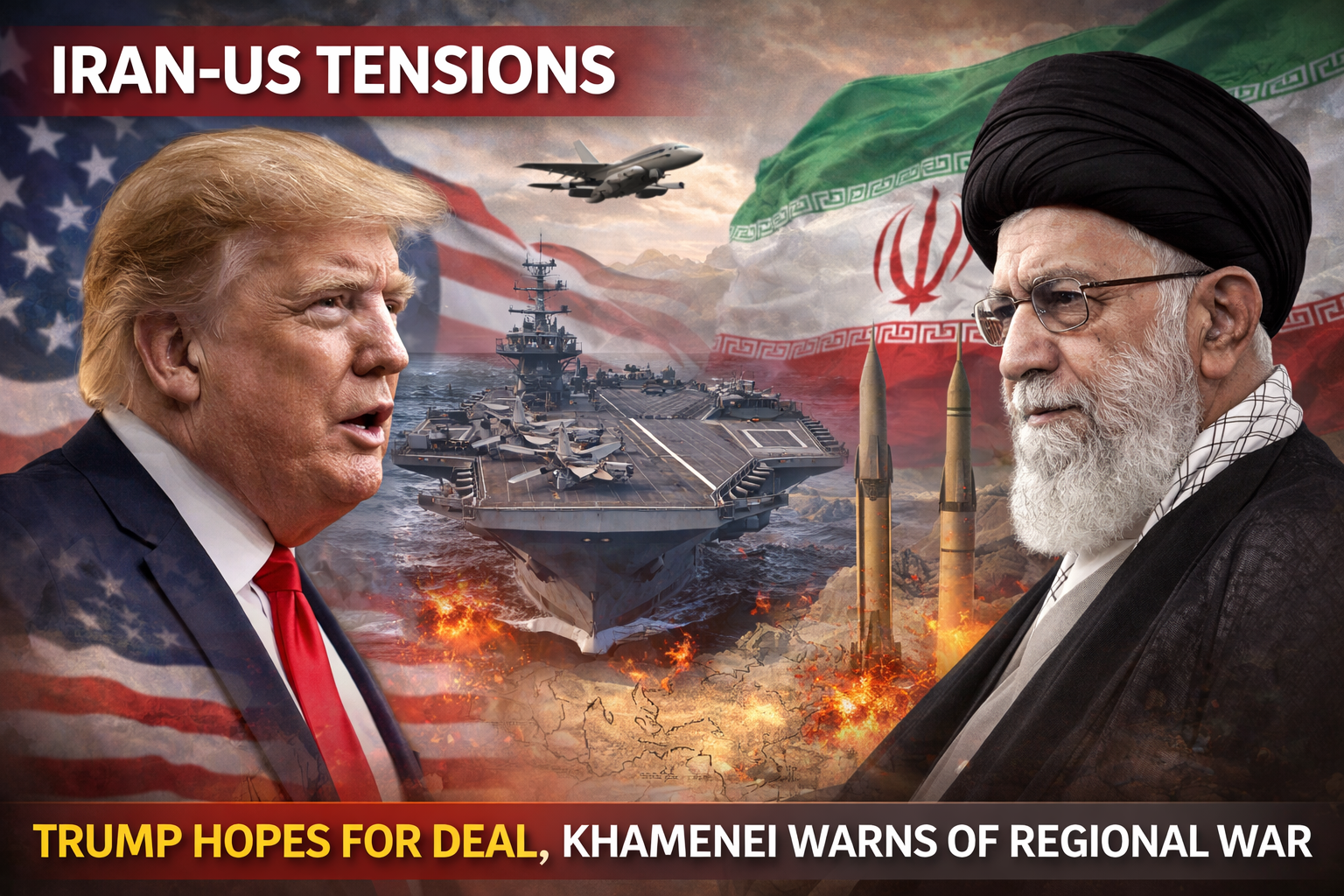
Iran–US Tensions Escalate: Trump Hopes for a Deal, Khamenei Warns of Regional War
Tensions between the United States and Iran have escalated sharply in recent days, with US President Donald Trump expressing optimism about reaching a potential deal with Iran, even as Iranian Supreme Leader Ayatollah Ali Khamenei warned that any US attack on Iranian territory would result in a “regional war.”
This development comes amid a backdrop of diplomatic strain, military maneuvers, and broader geopolitical anxieties that have ripple effects across the Middle East and the world.
Trump’s Position: Hopeful About Negotiations Despite Warning
In a brief statement made at Mar-a-Lago, President Trump was asked about Khamenei’s stark warning. Rather than reacting defensively, Trump appeared undeterred and emphasized his desire to resolve tensions via negotiations and a mutually agreeable deal.
Trump framed Iran’s rhetoric as typical in the face of geopolitical pressure, suggesting that public threats from Tehran were aimed at domestic audiences and regional allies rather than signaling imminent military action.
While the exact terms of any proposed deal remain unclear, Trump’s comments signal a diplomatic avenue that seeks to balance pressure with dialogue, with hopes of averting a wider conflict.
Khamenei’s Warning: “Regional War” if the US Attacks
Meanwhile, in Tehran, Supreme Leader Ayatollah Ali Khamenei delivered a forceful message to Washington, stating that any American military attack on Iran would not remain confined to the two countries, but would instead spiral into a regional war engulfing the Middle East.
Such language highlights the high stakes of the confrontation, especially at a time when military assets from both sides are positioned within striking distance of each other.
Khamenei’s warning serves multiple purposes:
-
Reassure Iranian allies and the domestic population of resistance to foreign aggression.
-
Signal to global actors that Iran will not tolerate external intervention.
-
Complicate any simplistic military calculus by the United States.
Contextual Background: A History of Friction
The U.S.–Iran relationship has been fraught for decades, going back to the 1979 Islamic Revolution and deteriorating significantly after the U.S. withdrawal from the Iran nuclear deal (JCPOA) in 2018.
More recent tensions have been driven by:
1. Nuclear Program Negotiations
Efforts to revive or reshape nuclear negotiations have waxed and waned. In 2025, talks between the United States and Iran took place in Oman, focused on curbing nuclear ambitions and re-establishing some form of agreement that could reduce hostilities.
While these talks did not yield a long-lasting pact, they laid groundwork for continued diplomatic engagement — a potential basis for Trump’s current optimism.
2. Military Presence and Maneuvers
The deployment of U.S. naval assets, including major vessels in the Gulf region, has been interpreted as both a deterrent and a source of escalation. Iran, in turn, has showcased its military drills and strategic positioning, signaling readiness to defend itself against perceived threats.
This dynamic has intensified fears of miscalculation that could lead to open conflict.
3. Domestic Unrest in Iran
Iran has also faced significant anti-government protests, which were met with a harsh crackdown by authorities. This human rights issue has added another layer of complexity to diplomatic relations, with the U.S. citing it as part of its rationale for increased pressure on Tehran.
Global and Regional Reactions
The reactions to these developments have resonated well beyond Tehran and Washington.
Middle Eastern Allies
Some U.S. allies in the Middle East, such as Gulf Cooperation Council (GCC) states, have expressed concern about a potential regional conflagration that could draw in multiple nations and disrupt global energy markets.
Neighboring countries often serve dual roles as diplomatic intermediaries and strategic partners. Their calculus now includes balancing relations with both the U.S. and Iran to preserve stability.
International Diplomacy
Global powers including the European Union and others have urged restraint from both sides while supporting diplomatic channels. At the same time, sanctions and political pressure continue to shape Iran’s foreign relations.
The Nuclear Question: Central to the Standoff
At the heart of the Iran–U.S. standoff remains the issue of Iran’s nuclear ambitions. While Tehran insists its nuclear program is for peaceful energy purposes, the United States and other international actors have historically viewed it as a potential pathway to weaponization.
This core concern has driven much of the antagonism:
-
Trump has repeatedly demanded progress toward a deal that would constrain nuclear development.
-
Iran has expressed willingness to engage diplomatically, but insists on conditions that preserve its sovereignty.
The threat of military action — real or rhetorical — continues to loom, even as both sides navigate the risks of escalation.
What Would a Regional War Mean?
Khamenei’s warning of a “regional war” should not be taken lightly. A conflict between the U.S. and Iran could:
-
Involve multiple armed groups and proxies across the Middle East.
-
Disrupt oil exports through key maritime routes like the Strait of Hormuz.
-
Draw in regional powers such as Israel, Saudi Arabia, and others.
-
Trigger global economic ripple effects.
Military analysts caution that even a limited skirmish could quickly broaden, especially if allies on either side become involved.
Trump’s Strategic Messaging
Trump’s public optimistic overtures about a deal appear designed to achieve several objectives:
-
Reduce the perception of inevitable conflict.
-
Appeal to domestic and global audiences concerned about war.
-
Signal readiness for negotiation without capitulation.
His statements have thus become a delicate balance — holding the line on U.S. strategic interests while keeping the door open for diplomacy.
The Path Forward: Diplomacy, Risk, and Uncertainty
As of now, there is no definitive breakthrough in negotiations. However, Trump’s remarks suggest a diplomatic track remains possible even in tense circumstances.
Iran’s leadership, on the other hand, emphasizes deterrence and regional strength, making clear that military options remain on the table — with potentially catastrophic consequences.
The situation remains fluid. Key factors to watch include:
-
Further diplomatic engagement or negotiations.
-
Shifts in military posturing by either side.
-
Regional responses from Middle Eastern governments.
-
International pressure through economic or political channels.
❓ FAQs (SEO & Discover Friendly)
Q1. What did Ayatollah Khamenei warn about?
He warned that any U.S. military attack on Iran could trigger a “regional war” across the Middle East.
Q2. What did President Trump say about Iran?
Trump expressed hope that the U.S. and Iran could reach a negotiated deal despite ongoing tensions.
Q3. Why are tensions rising now?
Recent military positioning, past nuclear talks, and unrest in Iran all contribute to heightened tensions.
Q4. Is war imminent?
Experts caution that while serious rhetoric and military build-ups increase risk, neither side has confirmed a direct move toward full-scale war yet.
Q5. What is at stake in U.S.–Iran relations?
Major points include nuclear negotiations, regional influence, and strategic military balance