


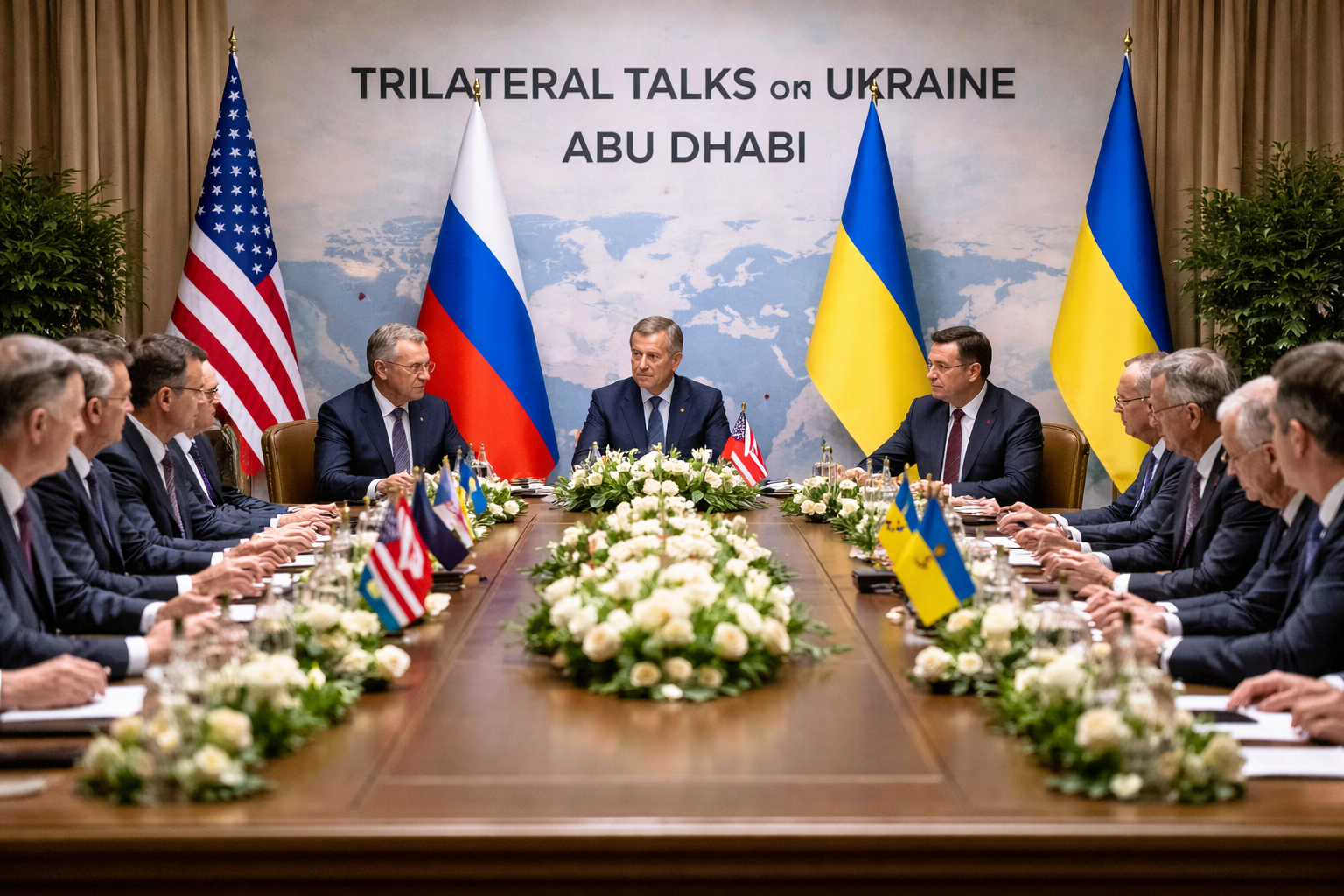
In a significant diplomatic breakthrough, the United States, Russia, and Ukraine have begun trilateral negotiations in Abu Dhabi, marking the first direct three-party talks since Russia’s invasion of Ukraine in 2022. The discussions, aimed at exploring potential peace frameworks, have drawn intense global attention as world powers cautiously assess whether diplomacy can succeed where years of conflict have failed.
Hosted in the United Arab Emirates, the talks represent a rare moment of convergence among deeply divided parties and signal a potential shift in the international approach to ending one of the most destabilizing conflicts of the past decade.
🌍 Why Abu Dhabi Was Chosen as the Venue
Abu Dhabi’s emergence as the host city is no coincidence. The UAE has increasingly positioned itself as a neutral diplomatic broker, maintaining working relationships with both Western powers and Russia while supporting international stability initiatives.
Diplomatic analysts note that the UAE’s balanced foreign policy and strong security environment made it a suitable location for sensitive negotiations that would be politically difficult to host elsewhere.
The choice of Abu Dhabi also underscores the growing role of the Middle East in global diplomacy, extending beyond traditional Western or European venues.
🤝 First Trilateral Talks Since 2022
While bilateral engagements and backchannel communications have occurred intermittently since 2022, this marks the first time the U.S., Russia, and Ukraine have sat at the same negotiating table to discuss a comprehensive peace framework.
Officials familiar with the talks emphasized that these negotiations are exploratory rather than conclusive, focusing on identifying areas of possible compromise rather than drafting a final agreement.
“This is not a peace deal,” one diplomatic source said. “It is a test of whether diplomacy still has space to operate.”
🗺️ Territorial Issues at the Center of Debate
One of the most sensitive topics on the agenda is the status of eastern Ukrainian territories, which have been at the heart of the conflict since its early stages.
According to sources briefed on the discussions:
-
Ukraine has reiterated its commitment to territorial sovereignty
-
Russia has raised concerns about security and regional autonomy
-
The U.S. has focused on ceasefire mechanisms and long-term stability
Territorial concessions remain highly contentious, with Ukrainian officials facing domestic pressure to avoid any compromise that could legitimize territorial losses.
⚠️ Global Powers Watching Closely
The talks are being closely monitored by European allies, China, and NATO, all of whom have significant strategic interests in the outcome.
European leaders have expressed cautious optimism while emphasizing that any agreement must respect international law. Meanwhile, China has welcomed diplomatic efforts, reinforcing its long-standing call for negotiated solutions.
NATO officials, while not directly involved, remain focused on ensuring that any framework does not undermine regional security or set dangerous precedents.
🇺🇸 U.S. Position: Stability and De-escalation
The U.S. delegation has reportedly emphasized de-escalation, humanitarian access, and confidence-building measures as initial steps toward peace.
American officials have consistently argued that sustained conflict risks:
-
Broader regional instability
-
Prolonged humanitarian suffering
-
Increased global economic disruption
While reaffirming support for Ukraine, the U.S. appears open to facilitating dialogue if it leads to a durable and enforceable peace.
🇺🇦 Ukraine’s Stance: Sovereignty and Security
Ukraine enters the talks under intense domestic and international scrutiny. President Volodymyr Zelensky’s government has made clear that any peace framework must preserve Ukraine’s sovereignty and security guarantees.
Ukrainian negotiators have reportedly pushed for:
-
Full respect for territorial integrity
-
International security assurances
-
Accountability mechanisms
For Kyiv, the challenge lies in balancing diplomatic engagement with the expectations of a population deeply affected by years of war.
🇷🇺 Russia’s Calculated Engagement
Russia’s participation in the trilateral talks marks a notable diplomatic shift. Analysts suggest Moscow may be seeking:
-
Sanctions relief discussions
-
Security guarantees
-
Recognition of strategic interests
While Russian officials have framed the talks as pragmatic, skepticism remains high among Western observers regarding Moscow’s long-term intentions.
🕊️ Humanitarian Concerns and Confidence-Building
Beyond territorial disputes, humanitarian issues form a critical part of the discussions. These include:
-
Prisoner exchanges
-
Protection of civilians
-
Reconstruction of war-affected regions
Diplomats argue that progress on humanitarian measures could help build trust and create momentum for broader political agreements.
📉 Economic and Global Implications
The Ukraine conflict has had far-reaching consequences for the global economy, affecting:
-
Energy markets
-
Food supply chains
-
Inflation levels worldwide
Any progress toward peace could ease pressure on global markets and restore confidence, particularly in Europe and emerging economies dependent on stable trade flows.
🔮 Cautious Optimism, Realistic Expectations
Despite the historic nature of the talks, experts warn against excessive optimism. Similar efforts in the past have stalled due to entrenched positions and shifting battlefield dynamics.
Still, the mere fact that trilateral negotiations are underway is seen as a meaningful diplomatic development.
“Dialogue does not guarantee peace,” a senior analyst noted, “but without dialogue, peace is impossible.