


Delhi Tragedy: Biker Dies Falling Into Open Pit — Delhi Infrastructure Safety Outrage Explained
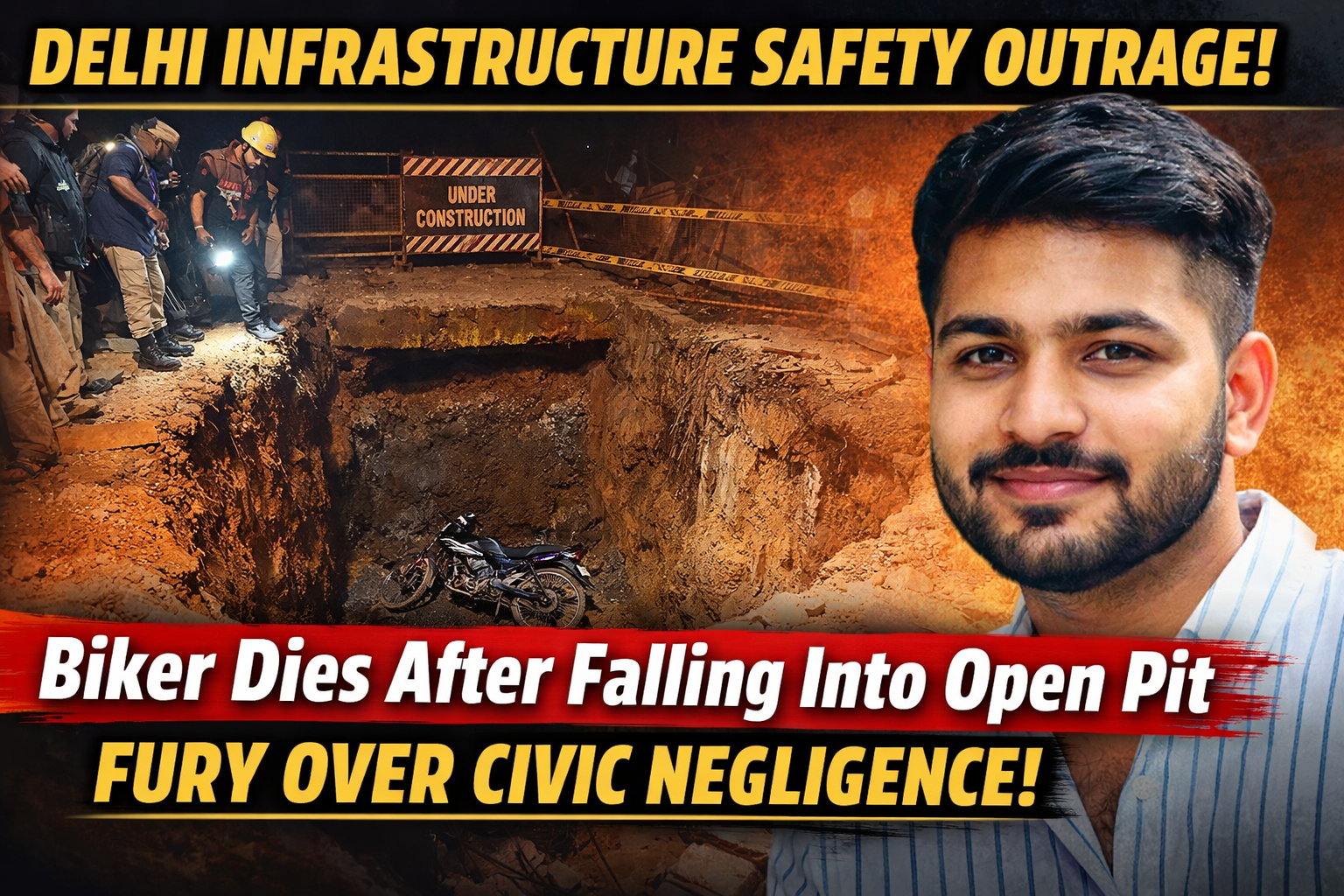
Delhi Infrastructure Safety Outrage has erupted after a horrifying incident in West Delhi’s Janakpuri area, where a 25-year-old motorcyclist died after falling into an open construction pit in the early hours of Friday. The young man’s death, part of a disturbing pattern of tragic accidents linked to uncovered or poorly marked excavation sites, has sparked intense public anger, legal action, political blame and urgent calls for accountability from city authorities.
Late on Thursday night, Kamal Dhyani, a 25-year-old resident of Kailashpuri and a telecaller at HDFC Bank, was returning home from his night shift in Rohini. Just 15 minutes away from home, he spoke to his brother and said he would be there soon — but he never made it. Early Friday morning, local residents and police found his body and motorcycle at the bottom of a deep, open construction pit dug for drainage and sewer repairs by the Delhi Jal Board (DJB).
A Deep, Dark Pit and a Life Lost
The construction pit into which Kamal fell was reportedly around 20 feet long, 14 feet wide and 13 feet deep, positioned on a service road near Professor Jogender Singh Marg in Janakpuri, adjacent to residential colonies and everyday commuter pathways.
According to the FIR registered by Delhi Police, the pit was left uncovered and lacking crucial safety measures. Police documents explicitly mention the absence of barricades, warning signs, reflectors and proper lighting at the site, leaving motorists and pedestrians vulnerable during nighttime movement.
Despite the DJB’s claims that the pit and surrounding road were “secured with green mesh and barricaded”, residents and the victim’s family have disputed this account, alleging lax safety precautions and incomplete or misleading site protection.
CCTV footage from the area is reportedly not available to clarify exactly how the accident unfolded, but preliminary investigations indicate that Kamal’s motorcycle plunged abruptly into the excavation as he navigated the dark stretch of road — a tragic end to an ordinary journey home.
Family’s Harrowing Search and Delay in Help
The human toll of this infrastructure lapse has struck a deep chord with the public because of the harrowing way Kamal’s family discovered what had happened. According to relatives and friends, his silence through the night raised alarm, prompting them to search for him across six different police stations — Janakpuri, Sagarpur, Vikas Puri, Rohini and others — only to be turned away or given little help until around 7:30 AM, when they were finally informed of his body being recovered from the pit.
This chilling wait — a night of desperate searching and unanswered pleas for help — has heightened emotions in the capital and ignited fierce criticism of the authorities’ emergency response and civic duty.
Public Outrage and Political Firestorm
The Delhi Infrastructure Safety Outrage has not remained confined to media headlines and social media posts — it has spilled into street protests, political debate and sharper blame games. Local residents, opposition politicians and citizen activists have labelled this incident “preventable” and an example of systemic negligence in civic infrastructure management.
Senior political figures, including Opposition leaders, have gone as far as calling the tragedy “not an accident, but a killing by neglect” — implicating not just local contractors but government leadership responsible for urban safety protocols.
The anger has been fueled by comparisons with another recent fatal infrastructure accident in Noida, where a 27-year-old techie drowned after his car plunged into an unbarricaded construction pit late in January — underscoring a growing pattern of deadly lapses in even major urban centers.
Accountability: FIRs, Arrests and Suspensions
In swift response to the Delhi Infrastructure Safety Outrage, the police have registered an FIR under Section 105 of the Bharatiya Nyaya Sanhita for culpable homicide against the DJB officials and the sub-contractor responsible for excavation works.
Officials at both the Delhi Jal Board and Public Works Department have faced harsh scrutiny. Three engineers — a junior engineer, an assistant engineer, and an executive engineer associated with the project — have been suspended by the Delhi government as preliminary action pending the ongoing investigation.
Additionally, sub-contractor Rajesh Prajapati — whose firm was reportedly tasked with overseeing the construction site — has been arrested by Delhi Police, marking a significant escalation in legal accountability for the tragedy.
The government has also ordered a formal probe and established an inquiry committee to investigate compliance with safety norms and to recommend punitive action against those found responsible.
Safety Norms Under the Spotlight
This death has brought renewed attention to longstanding concerns about infrastructure safety standards and enforcement in India’s capital. Civil engineers, safety advocates and traffic experts point out that:
-
Excavation sites on public roads should always be accompanied by proper barricades, reflective signage and lighting; missing any of these can turn a routine work zone into a death trap.
-
Accumulated piles of excavation earth near road edges can lead to drivers losing balance or misjudging road conditions.
-
Lack of traffic diversion plans and alert warnings dangerously exposes night-time commuters and pedestrians.
The Public Works Department (PWD) and Irrigation & Flood Control Departments have issued strong warnings to engineers that future lapses in safety compliance will invite serious action — highlighting a renewed emphasis on preventing such tragedies.
Civil Society and Citizen Response
Beyond political blame, ordinary citizens have taken to social media and protest spaces to express grief, outrage, and demands for systemic improvement. Many point to a pattern of incidents where lack of proper oversight has ended in loss of life — lamenting that public money meant for infrastructure safety has too often translated into unsafe work zones with inadequate protection.
Comments from residents and commuters on local forums and Reddit threads convey a collective frustration that such “death traps” on the road are avoidable, yet continue to claim lives across cities in the NCR.
The Human Cost: Remembering Kamal
At the heart of this political and safety debate is the life of 25-year-old Kamal Dhyani — described by friends and family as a jovial young man dedicated to his work and eagerly returning home after a night’s shift. His sudden and avoidable death has left his parents, twin brother, and extended family in deep sorrow, while raising hard questions about the everyday safety of Delhi’s roads.
Kamal’s story — a life lost mere minutes from home — resonates with commuters who traverse similar streets daily, often under dim street lighting and poorly marked construction zones. His family’s predicament — struggling through the night to find him — has become emblematic of larger failures in emergency response, civic responsibility and urban infrastructure oversight.
Broader Pattern: Urgent Need for Safety Overhaul
Experts emphasize that Kamal’s death is not isolated — but part of a broader pattern of tragic accidents tied to uncovered or inadequately protected pits in urban India. Between Noida’s recent fatal pit accident and similar incidents involving pedestrians and workers in Delhi, there is growing evidence that safety protocols are not being rigorously followed.
Road safety advocates argue that authorities must:
-
Enforce stringent barricading, proper lighting and warning signage at all construction zones.
-
Introduce independent safety audits before any road-oriented excavation projects begin.
-
Mandate 24/7 monitoring and supervision of high-risk worksites on public roads.
Without such reforms, critics warn, more preventable tragedies could occur on roads that are meant to serve and connect citizens — not endanger them.
FAQs — Delhi Infrastructure Safety Outrage
Q: What exactly happened in the Delhi tragedy?
A: A 25-year-old biker named Kamal fell into an uncovered construction pit dug by the Delhi Jal Board in Janakpuri and died — highlighting unsafe infrastructure practices.
Q: Why was the pit left open?
A: According to the FIR, the site lacked proper barricades, warning signs, reflectors and lighting — all essential safety measures for excavation zones.
Q: Who is being held responsible?
A: An FIR has been registered against DJB officials and the contractor; three engineers have been suspended and a sub-contractor has been arrested.
Q: What has the government done so far?
A: Authorities have ordered a probe, formed an inquiry committee, suspended responsible engineers, arrested the contractor and issued directives to enforce safety norms more strictly.
Q: Has this kind of incident happened before?
A: Yes — similar infrastructure-related deaths, including a recent Noida pit accident, have occurred, underscoring recurring safety issues.
Conclusion: A Tragedy That Forces Reckoning
The Delhi Infrastructure Safety Outrage goes beyond one heartbreaking death — it has exposed systemic negligence, sparked political disputes, triggered legal action, and renewed demands for public safety reforms in one of India’s busiest urban centers. Kamal’s untimely death is a sobering reminder that modernizing infrastructure must go hand in hand with protecting lives, and that accountability, vigilance and proactive safety planning are not optional — they are essential.