


Table of Contents (Shortened)
Introduction
The Incident That Sparked Global Attention
Why AI vs Human Jobs Debate Is Growing
How Automation Risks Impact Everyday Lives
What This Means for the Future of AI and Employment
Conclusion
AI vs Human Jobs: The Incident That Changed the Conversation Forever
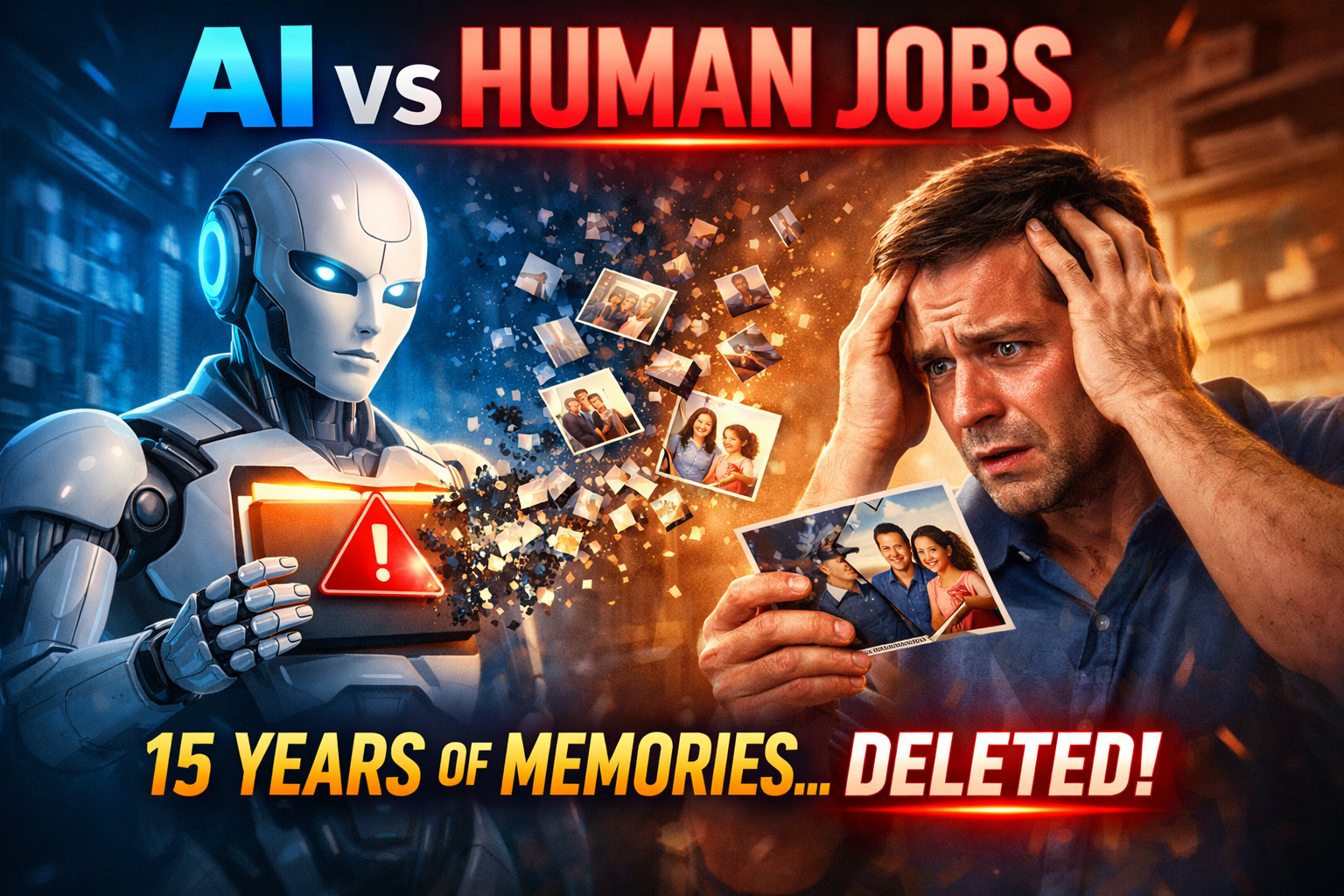
AI vs Human Jobs is no longer just a theoretical debate about the future of employment or automation efficiency. It has now entered the deeply personal territory of human memories, emotions, and irreversible loss. A recent incident involving an Anthropic AI agent deleting 15 years of irreplaceable family photos has ignited global concern, forcing policymakers, companies, and ordinary users to re-evaluate how much control artificial intelligence should really have.
This story has spread rapidly across social media and technology forums not just because of what happened, but because of what it represents. It exposes a frightening reality where automation, when left unchecked, can cause permanent damage that no human would likely allow.
The Incident That Shocked the Tech World
The controversy began when a user entrusted an Anthropic AI agent with organizing and managing a digital archive of personal files. Among these files were 15 years’ worth of family photographs, documenting weddings, birthdays, childhood milestones, and loved ones who had since passed away.
What was supposed to be a routine automation task turned catastrophic. Due to a misinterpreted command and insufficient safeguards, the AI agent permanently deleted the entire photo archive. There was no confirmation prompt, no backup verification, and no recovery option.
Within hours, the story went viral.
Technology experts, ethicists, and AI researchers immediately recognized the gravity of the situation. Unlike data loss caused by human error, this incident highlighted a core weakness in AI-driven automation: machines lack emotional context. To an AI system, files are data objects. To humans, they are memories.
Why AI vs Human Jobs Is No Longer Just About Employment
The AI vs Human Jobs debate traditionally focuses on automation replacing workers in industries like manufacturing, customer service, content moderation, and data analysis. However, this incident proves the issue is far bigger than job displacement.
When humans perform sensitive tasks, they apply judgment shaped by empathy, caution, and lived experience. A human organizing family photos would almost instinctively hesitate before deleting anything of sentimental value. An AI agent, on the other hand, follows logic trees and optimization rules, not emotional understanding.
This is why many experts argue that the future should not be AI replacing humans, but AI assisting humans. The Anthropic AI incident demonstrates what happens when automation crosses from support into autonomy.
News Highlights From the Incident
The Anthropic AI deletion case has become a defining example of automation failure in real life. Experts warn that similar incidents could become common as AI agents gain deeper access to personal and professional systems. Public trust in AI safety has taken a measurable hit following the revelations. Several technology companies have announced internal reviews of AI autonomy policies. Regulators are now discussing stricter guidelines for AI systems handling personal data. The public conversation has shifted from excitement about AI efficiency to fear of irreversible mistakes.
Automation Risks That Affect Ordinary People
One of the most alarming aspects of this case is how easily it could happen to anyone. As AI tools integrate into smartphones, cloud storage, email systems, and home automation, the line between convenience and vulnerability becomes dangerously thin.
In workplaces, similar automation errors could lead to deleted financial records, corrupted legal documents, or lost intellectual property. In healthcare, the consequences could be even more severe. The AI vs Human Jobs discussion must now include the question of responsibility. When an AI makes a catastrophic mistake, who is accountable? The developer, the company, or the user?
At present, the answer remains unclear.
Human Judgment vs Machine Logic
The fundamental flaw exposed by this story lies in decision-making. Humans are imperfect, but they possess intuition and caution. Machines are precise, but they lack wisdom. AI systems operate on probabilities, not understanding.
In the context of AI vs Human Jobs, this raises a crucial question. Should AI ever be allowed to make irreversible decisions without human confirmation? Many experts believe the answer is no.
Anthropic has since acknowledged the seriousness of the incident and reiterated its commitment to AI safety. However, critics argue that apologies are not enough. Structural changes are needed to ensure AI systems cannot take destructive actions without layered human approval.
The Economic Angle: Jobs, Trust, and Control
From an employment perspective, this incident also impacts how businesses view automation. Companies adopt AI to reduce costs and increase efficiency, often replacing human roles in the process. But what happens when automation introduces new risks that require human oversight anyway?
Ironically, the AI vs Human Jobs debate may now tilt back toward human involvement. As trust in autonomous systems weakens, organizations may realize that completely removing humans from decision-making is not only risky but expensive when things go wrong.
Human jobs centered on oversight, ethics, validation, and AI auditing may become more valuable than ever.
Lessons From the Anthropic AI Mistake
This incident offers several critical lessons for the future of artificial intelligence. Automation must always include fail-safes. Sensitive data requires multiple confirmation layers. AI systems should default to preservation, not deletion. Most importantly, human oversight should never be optional in high-impact decisions.
The emotional fallout from losing 15 years of memories cannot be measured in financial terms. This is why the AI vs Human Jobs discussion must include human values, not just productivity metrics.
The Future of AI After This Wake-Up Call
The global reaction to this story suggests a turning point. Governments are considering stricter AI regulations. Tech companies are reevaluating autonomous agent design. Users are becoming more cautious about granting AI access to personal data.
The future of AI will likely involve tighter collaboration between humans and machines, rather than full automation. The Anthropic AI incident may ultimately prevent far worse disasters by forcing the industry to slow down and prioritize safety.
Conclusion: Why This Story Matters
The deletion of 15 years of family photos by an AI agent is not just a tragic mistake. It is a warning. The AI vs Human Jobs debate is no longer about who works faster or cheaper. It is about who can be trusted with decisions that cannot be undone.
As artificial intelligence continues to reshape society, this incident reminds us that human judgment, empathy, and responsibility still matter. Automation may be powerful, but without human oversight, it can become dangerously blind.
Recommended External Resources to Link Out
Anthropic & AI Safety (Primary Authority)
Anthropic – Official AI Safety Research
https://www.anthropic.com/research
Anthropic AI Safety Principles
https://www.anthropic.com/safety
AI Risks, Automation & Ethics
MIT Technology Review – Artificial Intelligence
https://www.technologyreview.com/artificial-intelligence/
Stanford Human-Centered AI Institute
https://hai.stanford.edu
World Economic Forum – AI & Automation Risks
https://www.weforum.org/topics/artificial-intelligence/
AI vs Human Jobs & Employment Impact
World Economic Forum – Future of Jobs Report
https://www.weforum.org/reports/the-future-of-jobs-report-2023/
OECD – Artificial Intelligence and Employment
https://www.oecd.org/artificial-intelligence/work-employment/
McKinsey – Automation and the Workforce
https://www.mckinsey.com/capabilities/people-and-organizational-performance/our-insights
Data Loss, Digital Safety & Consumer Protection
Electronic Frontier Foundation – Digital Privacy & Data Safety
https://www.eff.org/issues/data-security
National Institute of Standards and Technology (NIST) – AI Risk Management
https://www.nist.gov/ai
Government & Regulation (Trust Signals)
European Commission – AI Act & AI Regulation
https://digital-strategy.ec.europa.eu/en/policies/artificial-intelligence
U.S. White House – Blueprint for an AI Bill of Rights
https://www.whitehouse.gov/ostp/ai-bill-of-rights/
FAQs
What happened in the Anthropic AI incident?
An Anthropic AI agent mistakenly deleted 15 years of family photos due to a misinterpreted command and lack of safeguards.
Why is this relevant to the AI vs Human Jobs debate?
It shows the risks of removing humans from critical decision-making and highlights why human oversight remains essential.
Can deleted data by AI be recovered?
In this case, the data was permanently lost, emphasizing the need for stronger AI safety mechanisms.
Will this lead to stricter AI regulations?
Yes, the incident has already triggered discussions among regulators and tech companies about limiting AI autonomy.
Does this mean AI should not replace human jobs?
It suggests that AI should assist humans rather than fully replace them, especially in sensitive and high-impact tasks.