


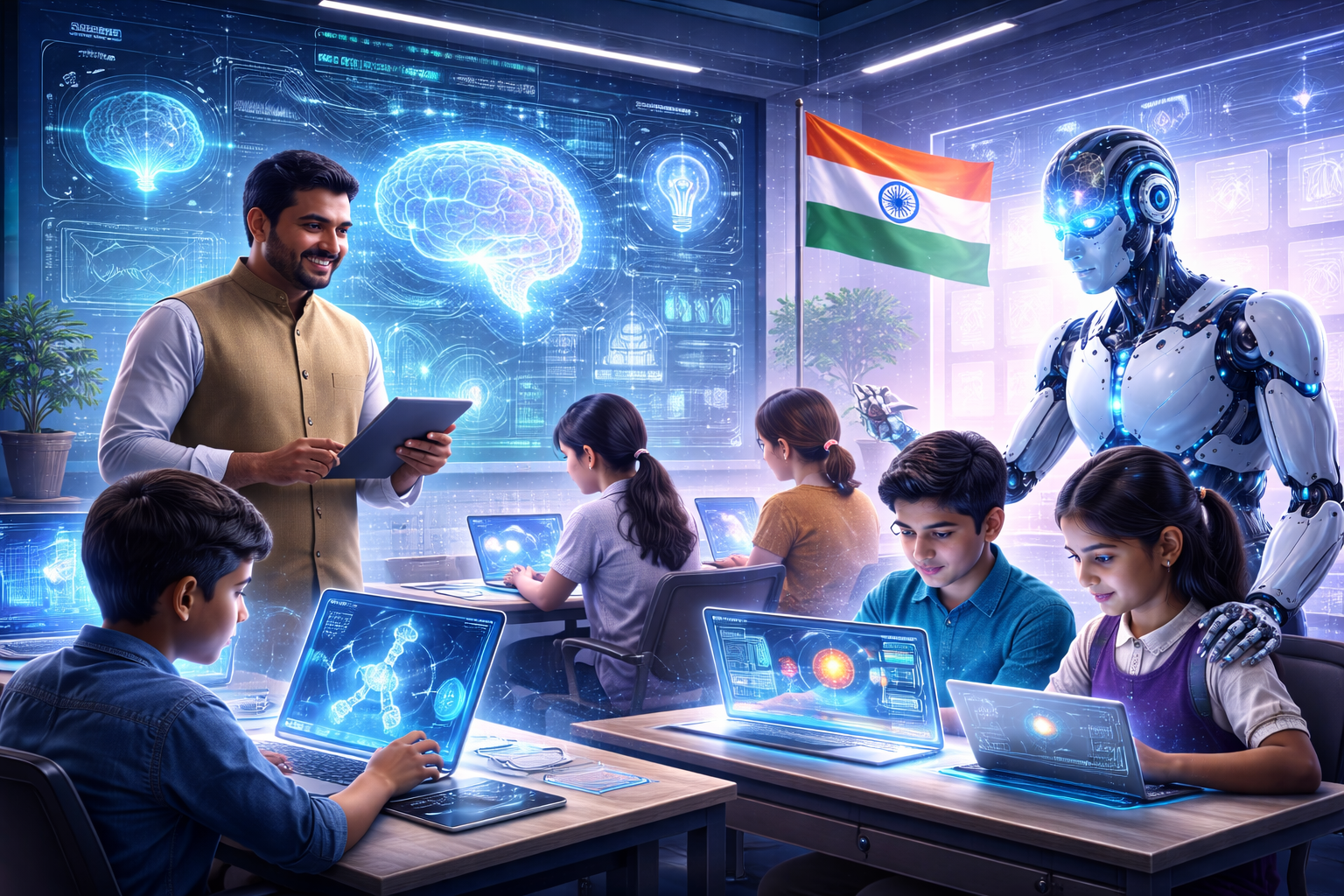
AI in Education India 2026 Sparks Massive Academic Shift
Table of Contents
-
AI in Education India 2026 Overview
-
AI in Education India 2026 and IIT Delhi Meeting
-
Role of Indian Startups in AI in Education India 2026
-
Government Vision for AI in Education India 2026
-
How AI Is Transforming Classrooms
-
Personalized Learning Through AI
-
AI in Teacher Support and Assessment
-
Data Privacy and Ethical Challenges
-
Global Trends in AI in Education
-
Future Roadmap for AI in Education India 2026
-
Conclusion
-
FAQs
News Highlights
Education Minister meets 10 AI startups
Focus on personalized digital learning
IIT Delhi hosts major AI discussion
Data privacy and ethics emphasized
AI integration aligned with NEP 2020
AI in Education India 2026: Full Detailed Analysis
AI in Education India 2026 is emerging as one of the most transformative initiatives in the country’s academic landscape. In a significant development, Union Education Minister Dharmendra Pradhan recently held discussions at IIT Delhi with ten Indian startups that are actively developing artificial intelligence solutions for the education sector. The meeting signals a decisive shift toward integrating advanced AI technologies into classrooms, administrative systems, and digital learning platforms across India.
AI in Education India 2026 represents more than just digital tools in schools. It reflects a broader vision of making education more accessible, personalized, data-driven, and outcome-oriented. As artificial intelligence technologies mature, their potential to revolutionize traditional teaching methods becomes increasingly evident.
The IIT Delhi meeting brought together startups working on adaptive learning platforms, AI-based tutoring systems, automated evaluation tools, predictive analytics for student performance, and multilingual learning assistants. These startups are building solutions that address some of India’s long-standing educational challenges, including teacher shortages, uneven learning outcomes, and access disparities between urban and rural areas.
The Ministry of Education’s broader digital transformation framework can be explored through official government resources at https://www.education.gov.in, which outlines India’s evolving education policy and digital initiatives. AI in Education India 2026 aligns closely with the National Education Policy 2020, which emphasizes technology integration, skill development, and future-ready curricula.
Artificial intelligence in education is not limited to automation. It fundamentally changes how students learn. AI-driven systems can analyze student performance data in real time, identify learning gaps, and recommend customized lesson plans. Instead of a one-size-fits-all classroom model, AI in Education India 2026 aims to create individualized learning pathways for each student.
Globally, AI-powered educational tools are gaining momentum. UNESCO’s guidance on AI in education can be accessed at https://www.unesco.org/en/artificial-intelligence, where global best practices and ethical considerations are discussed. These international insights are particularly relevant as India builds its AI-driven education framework.
One of the most promising aspects of AI in Education India 2026 is its potential to democratize learning opportunities. Rural and remote schools often struggle with limited access to qualified teachers. AI-powered virtual tutors can bridge this gap by delivering high-quality educational content regardless of location. Through speech recognition and multilingual support, AI systems can interact with students in regional languages, enhancing inclusivity.
Teacher support is another critical dimension. AI tools can assist educators by automating routine administrative tasks such as grading assignments, tracking attendance, and generating progress reports. This allows teachers to focus more on mentoring and interactive teaching. The integration of AI copilots in classrooms mirrors broader AI advancements seen in enterprise environments.
IIT Delhi’s role as host of the AI in Education India 2026 meeting highlights the importance of academic institutions in innovation ecosystems. Research institutions serve as incubation hubs for technology startups and policy experimentation. Collaboration between academia, government, and private startups strengthens India’s capacity to scale AI solutions responsibly.
However, AI in Education India 2026 also raises ethical and governance questions. Data privacy becomes paramount when educational platforms collect student performance metrics and behavioral data. Robust data protection frameworks must ensure that sensitive student information remains secure. India’s broader digital governance initiatives can be explored through https://www.meity.gov.in, which outlines technology policies and digital infrastructure frameworks.
Bias in AI algorithms presents another challenge. If training data is not representative, AI systems may inadvertently disadvantage certain groups. Therefore, transparency and auditability must be embedded in AI educational tools. Global discussions on AI ethics, including those led by the OECD, are available at https://www.oecd.org/ai.
AI in Education India 2026 also intersects with workforce development. As automation reshapes industries, educational institutions must prepare students for emerging technology careers. Coding literacy, data science fundamentals, and AI ethics are increasingly becoming part of curricula worldwide. Integrating AI tools within classrooms helps familiarize students with technologies that will shape their future professions.
From an economic perspective, AI-driven education can contribute significantly to India’s knowledge economy. By enhancing learning efficiency and reducing dropout rates, AI tools improve human capital development. Skilled graduates equipped with digital competencies strengthen India’s global competitiveness.
The Education Minister’s interaction with startups at IIT Delhi underscores the government’s intent to foster innovation within India’s EdTech ecosystem. Indian startups are uniquely positioned to design solutions tailored to local challenges, including multilingual environments and diverse socio-economic contexts.
Looking ahead, AI in Education India 2026 may expand beyond higher education into primary and secondary schooling. AI-powered career guidance systems could help students make informed decisions about academic pathways. Virtual labs and simulation environments may allow practical learning experiences even in resource-constrained schools.
Public-private partnerships will likely play a central role in scaling AI in Education India 2026 initiatives. Collaboration between government agencies, educational institutions, and technology firms can accelerate implementation while maintaining regulatory oversight.
In conclusion, AI in Education India 2026 marks a transformative chapter in India’s educational evolution. The IIT Delhi meeting between Dharmendra Pradhan and ten AI-driven startups reflects a forward-looking vision that blends policy leadership with technological innovation. While challenges related to data privacy, algorithmic bias, and equitable access must be addressed, the potential benefits are profound. AI-driven personalized learning, teacher support automation, and inclusive digital education ecosystems could redefine how knowledge is delivered and consumed in India.
FAQs – AI in Education India 2026
What is AI in Education India 2026?
It refers to India’s push to integrate artificial intelligence into classrooms and learning systems.
Why did the Education Minister meet AI startups at IIT Delhi?
To explore innovative AI-driven educational solutions and strengthen digital learning infrastructure.
How does AI improve education?
AI enables personalized learning, automated assessments, and data-driven academic insights.
Is AI safe for student data?
Proper data protection policies and regulatory frameworks are essential to ensure safety.
Will AI replace teachers?
AI is designed to support teachers, not replace them, by automating routine tasks.