


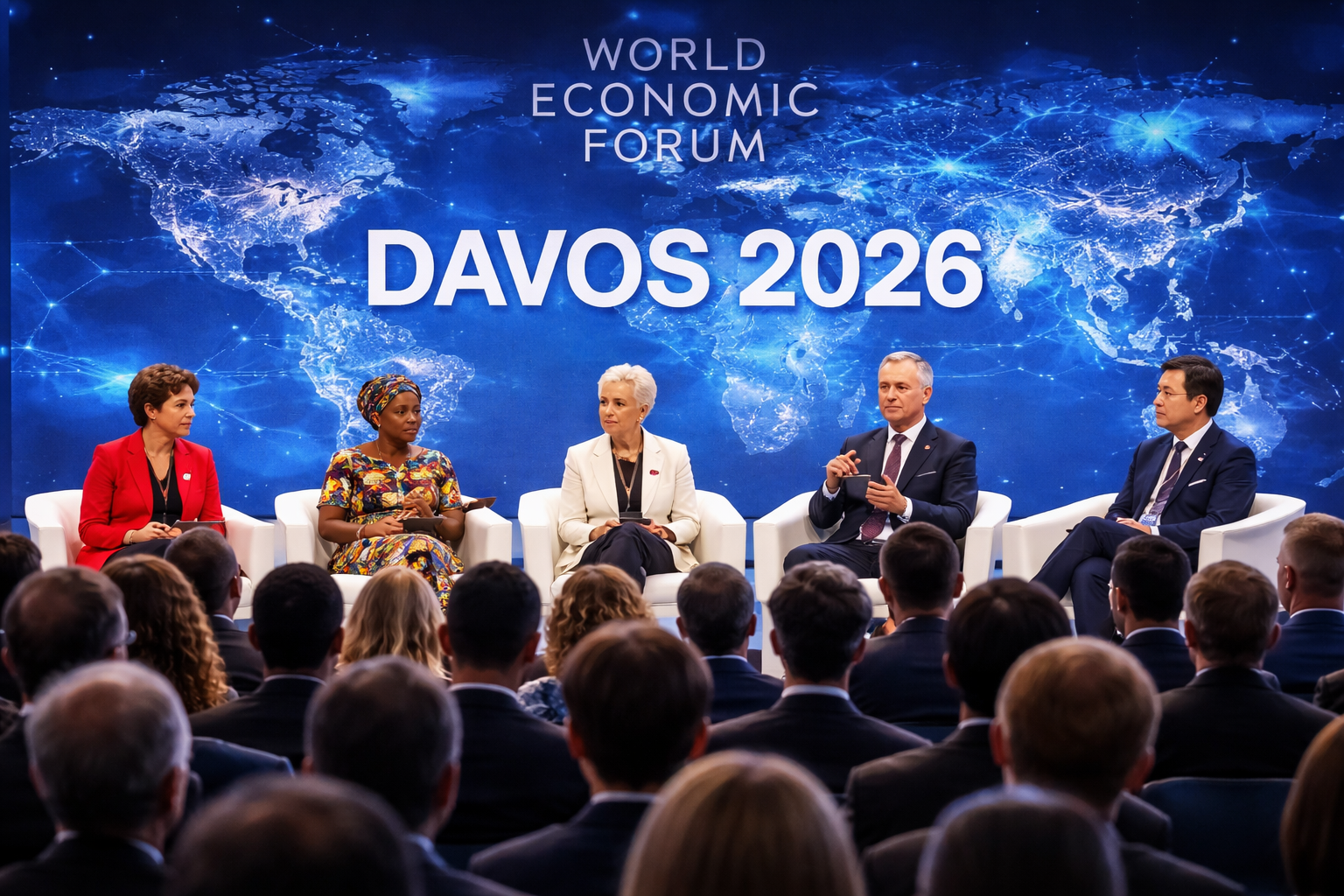
Global Economy Shows Resilience at Davos 2026 Amid Uncertainty
The global economy has demonstrated remarkable resilience, according to world leaders and financial experts gathered at the 56th World Economic Forum (WEF) in Davos 2026. Despite persistent geopolitical tensions, rising national debt levels, and economic inequality, leaders from major institutions such as the International Monetary Fund (IMF), World Trade Organization (WTO), and European Central Bank (ECB) struck a cautiously optimistic tone about the global outlook.
This year’s Davos discussions reflected a world navigating complexity rather than crisis—one where growth is uneven, risks are high, but economic systems have adapted better than many predicted.
🌐 Davos 2026: A World Shaped by Risk and Adaptation
The theme dominating conversations at Davos 2026 was resilience in the face of disruption. Global leaders acknowledged that the world economy continues to operate under pressure from:
-
Ongoing geopolitical conflicts
-
Fragmentation of global trade
-
High sovereign debt levels
-
Persistent inflationary pressures in select regions
Yet, compared to fears of a global recession voiced in earlier years, many policymakers now see a more stable, if fragile, economic environment.
IMF representatives noted that while growth remains slower than pre-pandemic averages, systemic collapse risks have declined, and financial markets are adjusting to a “new normal” of higher interest rates and tighter fiscal discipline.
💼 IMF: Growth Slower, But More Stable
The International Monetary Fund emphasized that global growth in 2026 is expected to remain modest but steady. According to IMF officials, strong labor markets in advanced economies and improving domestic demand in parts of Asia and Latin America are helping to offset weaknesses elsewhere.
However, the IMF warned that high public debt levels remain one of the most serious long-term threats. Many governments accumulated massive debt during recent crises, leaving limited room to respond to future shocks.
“The global economy is not booming, but it is coping,” one IMF official stated, highlighting that policy coordination and financial regulation have improved since previous downturns.
📉 ECB: Inflation Tamed, Risks Remain
The European Central Bank struck a balanced tone, noting progress in controlling inflation across the eurozone. After years of aggressive interest rate hikes, price pressures have eased, offering some relief to households and businesses.
Still, ECB leaders cautioned that geopolitical instability, particularly disruptions to energy supplies and trade routes, could quickly reignite volatility.
Europe’s economic resilience, they argued, now depends on:
-
Energy diversification
-
Strategic industrial policy
-
Investment in digital and green transitions
🚢 WTO: Trade Is Changing, Not Collapsing
One of the most closely watched discussions at Davos 2026 centered on global trade dynamics. The World Trade Organization acknowledged that trade growth has slowed and become more regionalized, but rejected the idea that globalization is ending.
Instead, WTO leaders described a shift toward:
-
“Friend-shoring” and regional supply chains
-
Strategic trade partnerships
-
Increased trade among emerging economies
While tensions between major powers continue to reshape trade policies, the WTO stressed that global trade volumes remain resilient, supported by digital commerce and services trade.
⚠️ Geopolitical Risks Still Loom Large
Despite the optimistic undertones, Davos participants repeatedly returned to geopolitical risks as the biggest wildcard for the global economy.
Conflicts, trade disputes, and political polarization were seen as ongoing threats that could:
-
Disrupt supply chains
-
Increase commodity price volatility
-
Undermine investor confidence
Business leaders urged governments to prioritize diplomacy and multilateral cooperation, warning that economic fragmentation could erode long-term growth.
⚖️ Economic Inequality: A Growing Concern
Economic inequality emerged as one of the most pressing social and political issues discussed at Davos 2026. While global GDP has stabilized, the benefits of growth remain unevenly distributed.
Leaders pointed out that:
-
Wage growth has lagged behind productivity in many regions
-
Developing economies face higher borrowing costs
-
Access to technology and education remains unequal
Several speakers warned that failing to address inequality could fuel social unrest and political instability, ultimately threatening economic resilience itself.
💡 Technology and Productivity: A Bright Spot
One area of optimism at Davos 2026 was the role of technology and innovation. Advances in artificial intelligence, automation, and digital infrastructure were highlighted as key drivers of future productivity gains.
Executives and policymakers agreed that:
-
AI adoption is accelerating across industries
-
Digital trade is creating new growth opportunities
-
Productivity gains could offset aging populations in developed economies
However, they also stressed the need for responsible regulation and workforce reskilling to ensure technology-driven growth benefits society as a whole.
🌱 Sustainability and the Green Economy
Sustainability remained central to economic discussions, with leaders arguing that climate investment is no longer optional but economically necessary.
Green energy projects, climate-resilient infrastructure, and sustainable finance were described as engines of future growth rather than costs. Many leaders emphasized that countries investing early in green transitions are likely to gain a competitive edge.
🔮 Outlook: Resilient, But Not Immune
As Davos 2026 concluded, a clear consensus emerged: the global economy is resilient but not invulnerable.
While worst-case scenarios have been avoided, risks remain elevated. Policymakers face the difficult task of balancing debt reduction, growth stimulation, and social stability in an increasingly fragmented world.
The message from Davos was not one of complacency, but of cautious confidence—an acknowledgment that the global economy has adapted to uncertainty, even as new challenges continue to emerge.